Are we all Exhausted by Aspiration?
How Disney became the antithesis of modern branding
I've spent over 20 years in branding. Long enough to become slightly immune to it as a consumer. I can usually unpick the brand strategy underneath: the emotional cues, the intent, the persuasion.
And then I found myself in Disneyland Paris.
The pull of Disney started before I'd even boarded the plane. I'd booked the trip on a whim for my niece's fifth birthday. She was turning five and Disneyland Paris felt like the kind of milestone that deserved a surprise visit from her Auntie Hannah.
I found myself scrolling Instagram for Disney outfit inspiration and trawling eBay for vintage Disney tees. Before I'd even packed a suitcase, I'd popped into the Disney Store on Oxford Street and bought a pair of Minnie ears.
I was completely sucked in. Disney hadn't sold me a ticket. It had invited me into a world. And it left me wondering: how does a brand have the power to dismantle twenty years of professional armour and reconnect me with my inner child? I wanted to unpack what Disney does that so few brands can.
Most brands are built on aspiration, self-improvement and status signalling. They promise a better wardrobe, a better body, a better version of ourselves or our homes. Aspiration, in one form or another, has become the default language of marketing.
So what does it mean to build a brand that doesn't promise more, but instead gives us permission to be less?
Less guarded. Less performative. Less adult.
‘In a culture exhausted by aspiration, perhaps the most powerful thing a brand can offer is permission to simply be’
Hannah Shore
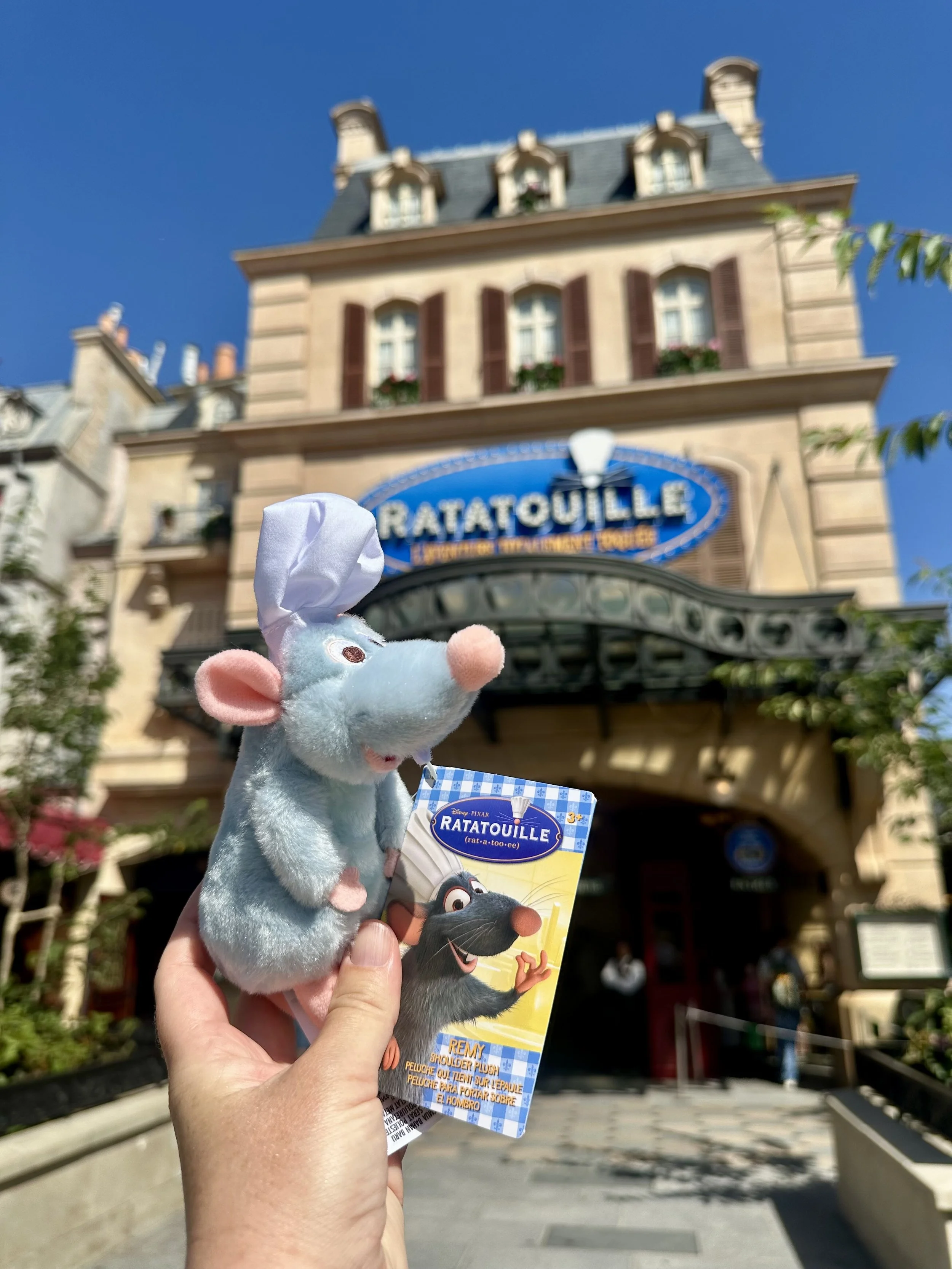
Remy from Ratatouille
There’s a Disney merch obsession called a shoulder pal: a small character plushie that sits on your shoulder using a magnet. After going on Ratatouille, a ride that brings to life the animated film of a rat who wants to be a chef, I bought my dad a Remy shoulder pal, a little chef, for my chef father.
My dad is a man in his sixties, more likely to comment on the length of a queue or the price of a coffee than embrace a novelty souvenir. And yet, that little rat spent the week perched on his shoulder and now sits beside the chef's hat in his kitchen. He was genuinely delighted by his new companion. And I was no better.
The excitement I felt took me straight back to my thirteen-year-old self in 1997, the first time I visited Disneyland Paris. This time, during the drive to the park, I was again, deliriously happy. Partly because my arrival was a complete surprise to my family, and partly because I was about to spend a few days running around a theme park with nothing else to worry about. When my sister put us in the virtual queue to meet Mickey Mouse, it was me who turned into the overstimulated child. And the photo of me and Mickey together? I look so happy I hardly recognise myself.
Again, I found myself questioning what exactly Disney had unlocked. Because it wasn't just me. Everywhere I looked, adults were giving themselves permission to play. Disneyland wasn't just allowing us to become versions of ourselves that adulthood rarely makes space for; it was actively encouraging it. What I was witnessing was a collective suspension of adulthood. Grandparents in mouse ears, grown men carrying plush toys and adults emotional at fireworks.
In its simplest form, Disney is a curator of happiness. But beneath it sits an extraordinarily sophisticated piece of emotional architecture, built on nostalgia, sensory immersion and storytelling. These aren't just marketing tactics; they're strategic assets that create emotional belonging.
To start with, Disney engineers nostalgia like no other brand. It not only creates new memories in the moment; it reactivates ones you didn't know you still had. You only have to step onto the 'It's a Small World' ride and you're stuck with an earworm for the rest of the day and transported straight back to childhood. Disney gets to us early, before we're guarded enough to resist. And once those stories are in, they stay. The songs you thought were long forgotten, the characters you shouldn't really know the names of. Nostalgia is what makes all that sensory detail land so hard.
Disney also understands something many brands forget: we don't remember experiences intellectually. We remember them sensorially. Smell, in particular, is engineered with real precision in the park. Disney calls the devices Smellitizers, hidden mechanisms that release scent into the air with the same precision as the lighting and sound. Main Street is scented with vanilla, a detail so subtle most visitors never notice it. When I think back to my first visit to Disneyland, one of my strongest memories was the scent of the Davy Crockett Ranch we stayed at. The smell of linseed oil on the wood. It takes me straight back to the excitement I felt going into the park for the first time. Disney doesn't just create experiences. It creates sense memories that last decades.
Disney's storytelling becomes even more powerful inside the parks because it moves beyond narrative and becomes physical. It's the embodiment of something Disney engineers viscerally. We don't have to learn the story. We already know it. Every touchpoint within the park reinforces the same narrative universe. The music, the architecture, the characters, the merchandise, even the food. Nothing sits outside the story.
The finale at the end of each day is the light show, Disney Tales of Magic. An edited anthology of every emotional Disney scene, projected onto the fairytale castle and choreographed to music and fireworks. It gives you just enough of each film to leave you wanting to watch the rest when you get home. At one point, a voiceover says, 'Every once in a while, magic finds you'. It's the epitome of storytelling and incredibly moving.
Each of those ingredients is powerful on its own. Together, they create something much rarer: a world that feels emotionally complete. Disney doesn't behave like a brand. It behaves like a place we already belong. This creates enough emotional safety for adults to participate without irony.
To wear the ears. To hug Mickey. To carry Remy on your shoulder.
This is what happens when a brand bypasses your critical mind entirely. Not by persuading you, but by suspending you.
Disney is the antithesis of modern branding in every emotional register. Yet strategically, it's the absolute pinnacle. They've cracked something no other brand has managed. They make the commercialism feel almost invisible, give or take a few extortionately priced snacks, while executing it with a scale and consistency no one else comes close to.
Perhaps that's why Disney feels so powerful right now. We live in a culture of endless optimisation. Even our downtime has become productive. Most brands try to make you feel like a better version of yourself. Disney makes you feel like an earlier version of yourself.
And that's harder to engineer, and more powerful, than aspiration.
Disney asks almost nothing of us except that we participate and suspend reality for a while. Nostalgia, storytelling and sensory immersion are simply the mechanics. What they create is something else entirely. Relief.
Maybe that's Disney's real magic. It doesn't help us imagine who we could become. It lets us remember who we were before we thought we needed to become anything else.
And in a culture exhausted by aspiration, perhaps the most powerful thing a brand can offer is permission to simply be.
‘Disney is the antithesis of modern branding in every emotional register. Yet strategically, it's the absolute pinnacle’
Hannah Shore